Bachelor of Science in Nursing - Bridge Option program guide
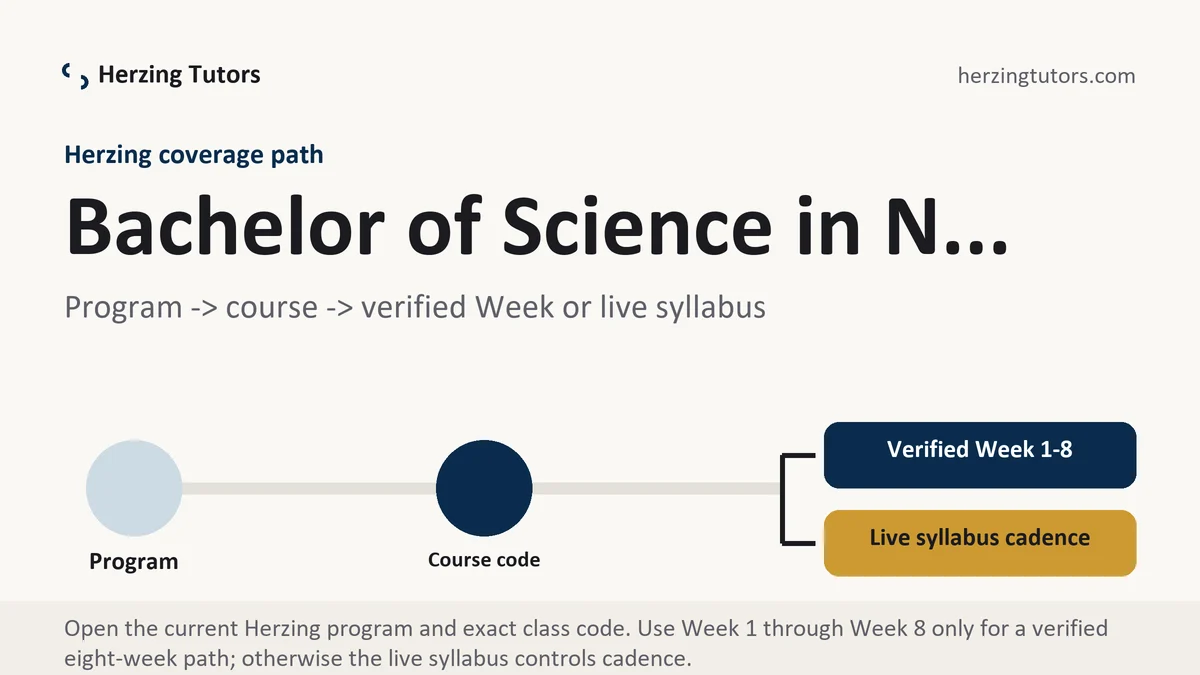
The current path in the order students use it: exact program, exact class code, then a verified Week manual or the live-syllabus control point.
This page links every unique course code printed in the current public curriculum groups for this program. Required courses, options, dual-credit choices, support courses, capstones, internships, and clinical components stay in their published groups instead of being flattened into one universal sequence.
Read the program map correctly
The May 2026 Undergraduate Catalog lists 31 unique codes across 4 curriculum groups for this path. A code can be required, optional, substitutable, or available only under a named track. Follow the group heading, then reconcile the public map with the registered degree audit.
Campus, state authorization, start date, transfer evaluation, prior license, clinical placement, bridge status, concentration, and catalog version can change an individual schedule. The official catalog is the source for public identity; the live degree audit is the source for the student's actual plan.
The classes, one by one
Required Courses in Nursing
| Course | Current catalog title |
|---|---|
| NSG 120 | Nursing Pathophysiology |
| NSG 124 | Pharmacology |
| NSG 126 | Transition to Professional Nursing |
| NSG 221 | Mental Health Nursing |
| NSG 222 | Family Nursing |
| NSG 223 | Medical-Surgical Nursing II |
| NSG 233 | Medical-Surgical Nursing III |
| NSG 321 | Advanced Leadership and Management |
| NSG 323 | Community and Public Health Nursing |
| NSG 324 | Evidence Based Practice in Nursing |
| NSG 421 | Nursing Informatics |
| NSG 423 | Policy, Trends, & Ethics in Nursing |
| NSG 425 | BSN Practicum |
| NSG 426 | Review of Integrated Nursing Concepts |
Dual Credit Option for Taking Graduate Level Courses
| Course | Current catalog title |
|---|---|
| NSG 321 | Advanced Leadership and Management |
| NU 730 | Systems-Based Practice |
| NSG 324 | Evidence Based Practice in Nursing |
| NU 602 | Epidemiology, Research, and Theory |
| NSG 421 | Nursing Informatics |
| NU 725 | Technology and Nursing Informatics in Advanced Practice |
| NSG 423 | Policy, Trends, & Ethics in Nursing |
| HA 610 | Health Policy and Management |
Required Courses in General Education
| Course | Current catalog title |
|---|---|
| EN 104 | English Composition I |
| EN 111 | Information Literacy |
| EN 116 | Speech |
| EN 304 | English Composition II |
| SC 154 | Anatomy and Physiology I for Nurses |
| SC 254 | Anatomy and Physiology II for Nurses |
| SC 166 | Microbiology |
| SC 186 | Chemistry |
| HU 140 | Cultural Diversity |
| HU 340 | Humanities and Contemporary Popular Culture |
| MA 109 | College Algebra |
| MA 320 | Statistics |
| PS 101 | Psychology |
Special General Education Grading Requirements for Nursing Support Courses
| Course | Current catalog title |
|---|---|
| SC 154 | Anatomy and Physiology I for Nurses |
| SC 254 | Anatomy and Physiology II for Nurses |
| SC 166 | Microbiology |
| MA 109 | College Algebra |
| MA 320 | Statistics |
Program → class → Week or live syllabus
Herzing publicly runs three 16-week semesters with 8-week A/B sessions and 4-week mini sessions, but the catalog does not assign one length to every course. This program page does not turn the academic calendar into a false Week map. The registered syllabus and Canvas shell control the actual cadence.
Where a Week manual exists, it controls the position and work method without inventing a topic. Open the live course first, copy the exact Week heading, directions, point value, rubric, discussion requirements, exam rule, file type, and deadline, then use the linked manual to plan and check the work.
Build the registered-course board
Give every obligation its own row: exact classroom label, course, Week or date, due time and time zone, points, grading band, prerequisite, evidence need, current status, feedback state, and next action. Keep discussions, written deliverables, quizzes, labs, clinical tasks, proficiency gates, and proctored exams in separate lanes.
After every posted result, reconcile the board with the gradebook. Record points earned and possible, remaining work, any exam-average or progression rule, and the smallest next action. This makes a long semester observable before a missed dependency becomes a late submission.
Turn directions and rubric into acceptance tests
Directions control the scenario, audience, length, file type, sources, and submission rules. The rubric controls what earns credit. Convert every requirement into a yes-or-no check and assign it a destination in the draft, calculation, presentation, care plan, or project file.
Complete a content pass before a delivery pass. First verify that every criterion is answered, claims match evidence, calculations expose inputs and units, and recommendations follow from the analysis. Then verify citation style, template, filename, accessibility, export, and upload rendering.
Clinical, exam, and professional boundaries
Verified proficiency, milestone, dosage-calculation, exit, and third-party proctored exams are preparation-only: study plan, practice questions, rationale review, and readiness decisions. No tutor can sit an exam, enter an authenticated environment, or impersonate a student.
Students complete clinical care, skills, simulations, patient or workplace decisions, practicum hours, preceptor communication, signatures, and experience records. Tutoring can explain concepts, help plan de-identified written work, review calculations, rehearse presentations, and help revise an original student draft.